
Japanese Design & Florals
Ikebana for Beginners: The Japanese Art of Flower Arranging (and the Right Vase for It)

Most flower arranging starts with abundance. You buy a bunch, strip the leaves, cut the stems at an angle, and arrange them until the vase is full. Ikebana starts from a different place entirely. It begins with a single stem held in the hand, a vessel chosen deliberately for its form, and a question: what is the minimum number of elements needed to express something true?
Ikebana — the Japanese art of flower arranging — is one of the oldest aesthetic practices in Japan, with roots stretching back to the 6th century. But it isn't a museum piece. It's a living practice that shapes how millions of people think about space, restraint, and the relationship between a vessel and what goes in it. Understanding even its basics will permanently change how you look at a vase.
This guide is for beginners. It covers what ikebana is, how it differs from Western floristry, the three styles most relevant to a home practice, and — crucially — which vessels make it possible at home.
This is part of our ongoing series on Japandi design and the objects that shape a considered home. Related reading: What Is Japandi Style?, Wabi-Sabi Ceramics Explained, and How to Style Vases Like an Interior Designer.
What Ikebana Actually Is
The word ikebana (生け花) translates roughly as "living flowers" — ikeru meaning to keep alive or to arrange, hana meaning flower. But the word doesn't capture the practice. Ikebana is more accurately described as a discipline of spatial composition using plant material. The flowers are the medium. The arrangement is the art.
What separates ikebana from Western flower arranging is its relationship to empty space. In Western floristry, the goal is usually fullness — a dense, generous arrangement where the vase is subordinate to the blooms. In ikebana, empty space is a primary design element, given as much intention as the stems themselves. The Japanese concept of ma — the meaningful pause, the charged interval — runs through every ikebana arrangement. The space between stems is where the arrangement breathes.
"In ikebana, the space between stems is not absence — it is as deliberately placed as the stems themselves."
Ikebana also treats the vessel as an equal participant in the arrangement. In Western floristry, the vase is infrastructure. In ikebana, the relationship between vessel and material is the point — their dialogue of form, weight, texture, and scale is what produces the final composition. You cannot separate them.
A Brief History: From Temple Offering to Living Room
Ikebana began as kuge — the Buddhist practice of offering flowers at altars, introduced to Japan from China around the 6th century. Over several hundred years it evolved from ritual offering into a refined artistic practice, shaped particularly by the tea ceremony culture of the Muromachi period (15th–16th century), where a single seasonal arrangement in a tokonoma alcove became as important as the tea itself.
Different schools developed different interpretations over the centuries. The oldest and most formal style — rikka — uses elaborate arrangements of nine or more elements to represent an idealized natural landscape. Later styles moved toward greater spontaneity and simplicity. By the 20th century, moribana had emerged as the most accessible modern style, designed around a shallow basin and visible mechanics — the style most natural for contemporary home practice.
Today there are hundreds of ikebana schools in Japan, each with its own philosophy. For a home practitioner who isn't enrolling in a formal school, what matters is understanding the three core styles and the vessel logic that underpins each one.
The Three Styles: What Each One Asks of the Vessel
You don't need to master all three. Understanding them gives you a framework for why certain vessels suit certain arrangements — which is the most practically useful thing a beginner can know.
Style 01
Moribana — "Piled-Up Flowers"
The most accessible style for beginners. Moribana uses a shallow, wide container — typically a flat basin or low bowl — with a kenzan (the pin-frog, a dense bed of metal spikes) holding the stems in place at precise angles. Because the mechanics are exposed and the container is wide, moribana arrangements tend to be horizontal and landscape-like, evoking a meadow, a hillside, or the edge of water.
The vessel for moribana is wide and low. A shallow bowl, a flat stone dish, or any container where the arrangement can spread laterally. The Round Ikebana Vase — with its weighted, orb-like form and wide flat opening — is designed with exactly this style in mind.
Style 02
Nageire — "Thrown In"
Where moribana is horizontal, nageire is vertical. The name means "thrown in" — a reference to the apparent spontaneity of the arrangement, where stems appear to have been placed with casual precision into a tall, narrow vessel. No kenzan is used; the stems lean against the vessel walls and each other, creating a natural diagonal tension.
Nageire calls for a vessel with height, a narrow mouth, and enough internal structure to support the stems at their intended angle. A tall cylinder, a flask-shaped jar, a vessel with a small opening that controls the angle of entry. The Big Belly Vase — with its wide body narrowing to a smaller mouth — is a traditional nageire form. One long branch of cherry blossom leaning at 45 degrees from the opening of a Big Belly is as close to a textbook nageire arrangement as a contemporary home gets.
Style 03
Shoka — "Living Flowers"
The most formal of the three styles accessible to home practitioners. Shoka arrangements are built around three primary stems representing heaven, earth, and humanity — a symbolic structure that produces asymmetric, triangular compositions of striking quiet authority.
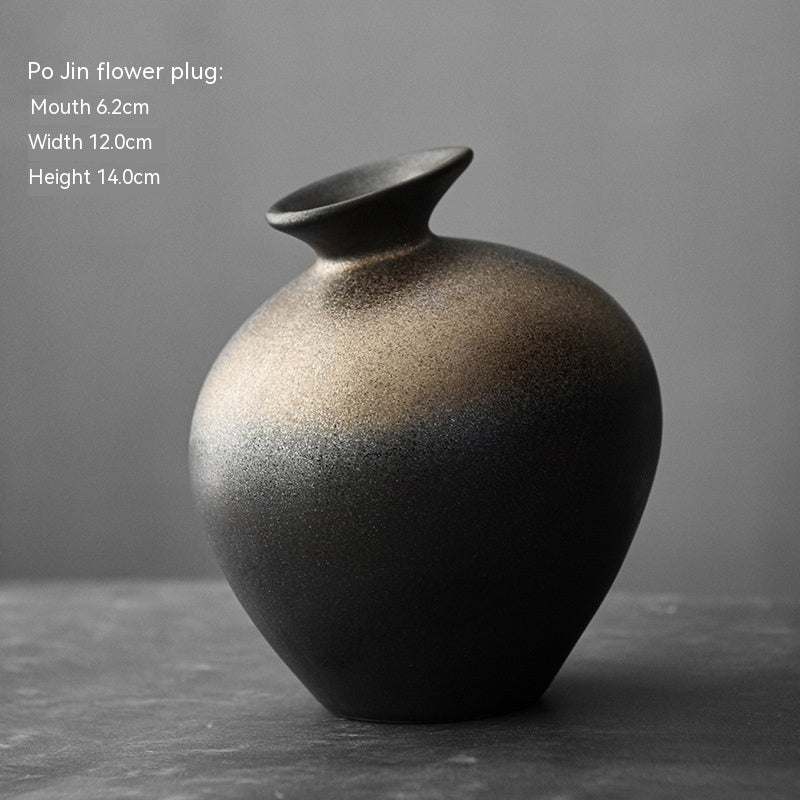
Shoka works in a mid-height vessel with a narrow opening, where the arrangement rises clearly above the rim and the three elements read distinctly. A stoneware tsubo vessel — the traditional vessel for shoka — is ideally suited. The Kasumi or Jomon stoneware vases, with their Japanese ceramic DNA, are natural candidates.
The Vessels: What Each Piece in the Collection Offers
Here are the four pieces from the Brooklyn Wax Vessels & Vases collection most directly suited to ikebana practice, with a note on which style each supports best.


Shoka & Nageire Vessel
Jomon Stoneware Vase
Ancient-Fired Wabi-Sabi Ceramic

The Jomon draws on Japan's oldest ceramic tradition, and that history makes it a natural shoka vessel. Its unglazed stoneware surface has the quiet gravity of something that has held flowers before — a vessel with memory. A three-element shoka arrangement using a bare branch, a
single grass stem, and one small blossom reads very differently against a rough-fired clay body than it does in a modern glass vessel. This is the arrangement for a room that values the ancient.
Shop →Tsubo Tradition
Kasumi Stoneware Vase
$89 · Earth & Plum · Sage & White


The Kasumi's teardrop silhouette places it squarely in the tsubo tradition — the broad-shouldered storage jar form that has been a canonical ikebana vessel across multiple schools for centuries. The narrowing neck controls the angle of entry exactly enough to make a single-stem nageire arrangement effortless: the stem leans against the neck, the belly provides counterbalance, and the reactive glaze provides a backdrop that changes color as the light shifts through the day.
Earth & Plum works best with warm dried botanicals — pampas, cotton, dried wheat. Sage & White is the better backdrop for a single green stem or white flower, where the celadon glaze and the botanical share the same cooler palette.
Shop the Kasumi Vase →A Beginner Practice: Your First Ikebana Arrangement in Five Steps
You don't need formal training to make a considered ikebana arrangement. You need a vessel, one or two stems, and the willingness to stop before you think you're finished.
Choose one vessel deliberately
Don't grab the nearest container. Look at what you have and ask: is this a moribana vessel (wide, shallow, horizontal) or a nageire vessel (tall, narrow, vertical)? That decision determines everything that follows.
Start with three elements, not one
The traditional ikebana structure uses three primary elements — shin (heaven/tallest), soe (man/medium), tai (earth/lowest). For a beginner, find one tall element (a branch or long grass), one medium (a secondary stem), and one short (a small blossom or leaf). These three create the asymmetric triangle that is the backbone of every ikebana style.
Place diagonally, not vertically
The most common beginner mistake is placing all stems straight up. Ikebana uses diagonal angles — the tall shin element leans slightly forward, the soe curves to one side, the tai angles toward the viewer. These angles create the spatial tension that gives the arrangement life. The stems should look like they grew at those angles, not like they were placed there.
Look at the space, not just the stems
Step back and look at the empty areas your arrangement creates. Is the space between the tall element and the medium one interesting? Does the arrangement have a clear front and a sense of depth? The space should feel as deliberate as the stems. If it doesn't, adjust one element — just one — and look again.
Stop before you think you're finished
Every beginner adds one element too many. The arrangement that felt almost right with three elements becomes crowded with four. Ikebana's restraint is a discipline, not a preference — it has to be practiced consciously. When you think you might be done, put the next stem down and live with what you have for ten minutes. Usually, what you have is enough.
What to Use: The Best Botanicals for Home Ikebana
| Botanical | Role in arrangement | Best vessel pairing |
|---|---|---|
| Cherry blossom branch | Shin — tall, primary line | Big Belly (nageire — the branch leans from the mouth) |
| Dried pampas grass | Shin or soe — tall, soft texture | Round Ikebana, Kasumi Earth & Plum |
| Dried eucalyptus | Soe — mid-height, color contrast | Jomon, Kasumi Sage & White (palette match) |
| Single white tulip | Tai — short, focal bloom | Round Ikebana (green variant — the contrast is striking) |
| Cotton stem | Tai — low accent, organic texture | Any — universally compatible with wabi-sabi ceramics |
| Bare winter branch | Shin — the most wabi-sabi choice, pure line | Big Belly or Jomon (the ceramic makes the branch feel ancient) |
The Scent Layer
Ikebana is a spatial art — it shapes the visual experience of a room. But a room has more dimensions than the visual. The practice of adding a Brooklyn Wax candle alongside an ikebana arrangement isn't decorative padding; it's the completion of the sensory composition.
The pairing logic follows the same restraint principle as the arrangement itself. Don't compete. A wabi-sabi ceramic holding a single eucalyptus stem belongs beside a candle with a similarly grounded, quiet scent — hinoki cedar, sandalwood, smoked vetiver. The eucalyptus and the cedar are already in conversation before the flame is lit. When it is, the room has a coherence that visual arrangement alone doesn't produce.
Complete the Composition
The arrangement and the candle.
Hand-poured in Greenpoint, Brooklyn. Earthy, grounded scents that belong next to a considered arrangement.
Browse All Vessels & Vases
11 pieces. Wabi-sabi ceramics and Nordic glass. Ships worldwide.
Shop the Collection →Frequently Asked Questions
Do I need a kenzan (pin-frog) to practice ikebana at home?
For moribana arrangements in a shallow, wide vessel, yes — a kenzan is what holds the stems at their angles. For nageire arrangements in a tall or narrow vessel, no. The stems lean against the vessel walls and each other for support, which is part of what gives nageire its spontaneous quality. If you're starting with the Round Ikebana Vase or a shallow basin, a small kenzan is worth having. They're inexpensive and widely available.
Can I use artificial or dried flowers for ikebana?
Dried botanicals, yes — and in many ways they're better suited to home practice than fresh flowers. Dried pampas, eucalyptus, cotton, and seed pods hold their angles without wilting, work with the natural colors of wabi-sabi ceramics, and last indefinitely. Artificial (plastic) flowers are generally incompatible with the wabi-sabi aesthetic that underlies ikebana — the synthetic material reads against the honesty that the whole practice is built on.
Does the vase have to be Japanese for ikebana?
No — the traditional ikebana schools do work with specific vessel forms (bronze, bamboo, traditional ceramic styles), but home practitioners aren't bound by school rules. What matters is that the vessel is chosen deliberately for its relationship to the material. A heavy Nordic glass orb can absolutely be an ikebana vessel if the arrangement uses it to create the spatial dialogue ikebana asks for. The Round Ikebana Vase is an example of a contemporary interpretation that works with the practice rather than against it.
How is ikebana different from just putting flowers in a vase?
Intentionality and restraint. Putting flowers in a vase is an action. Ikebana is a compositional discipline. The difference is: do you choose each element for its specific contribution to the whole, and do you actively consider the space between elements as a design element? If yes, you're practicing something close to ikebana. If you're filling a vase because it looks nicer with flowers in it, you're doing something different — which is fine, but it's not the same practice.
Where do I go next?
For the broader design context that ikebana sits within, our guide to wabi-sabi ceramics covers the philosophy behind the vessels. And our seven rules for styling vases gives you the practical framework for placing an ikebana arrangement in a wider interior context.
Brooklyn Wax Co. makes hand-poured soy candles, Japanese whisky glasses, and curated home goods from Brooklyn, NY. We believe the objects in your home should do something — elevate a moment, deepen a ritual, make Tuesday evening feel considered. Browse our full collection at brooklynwax.co.